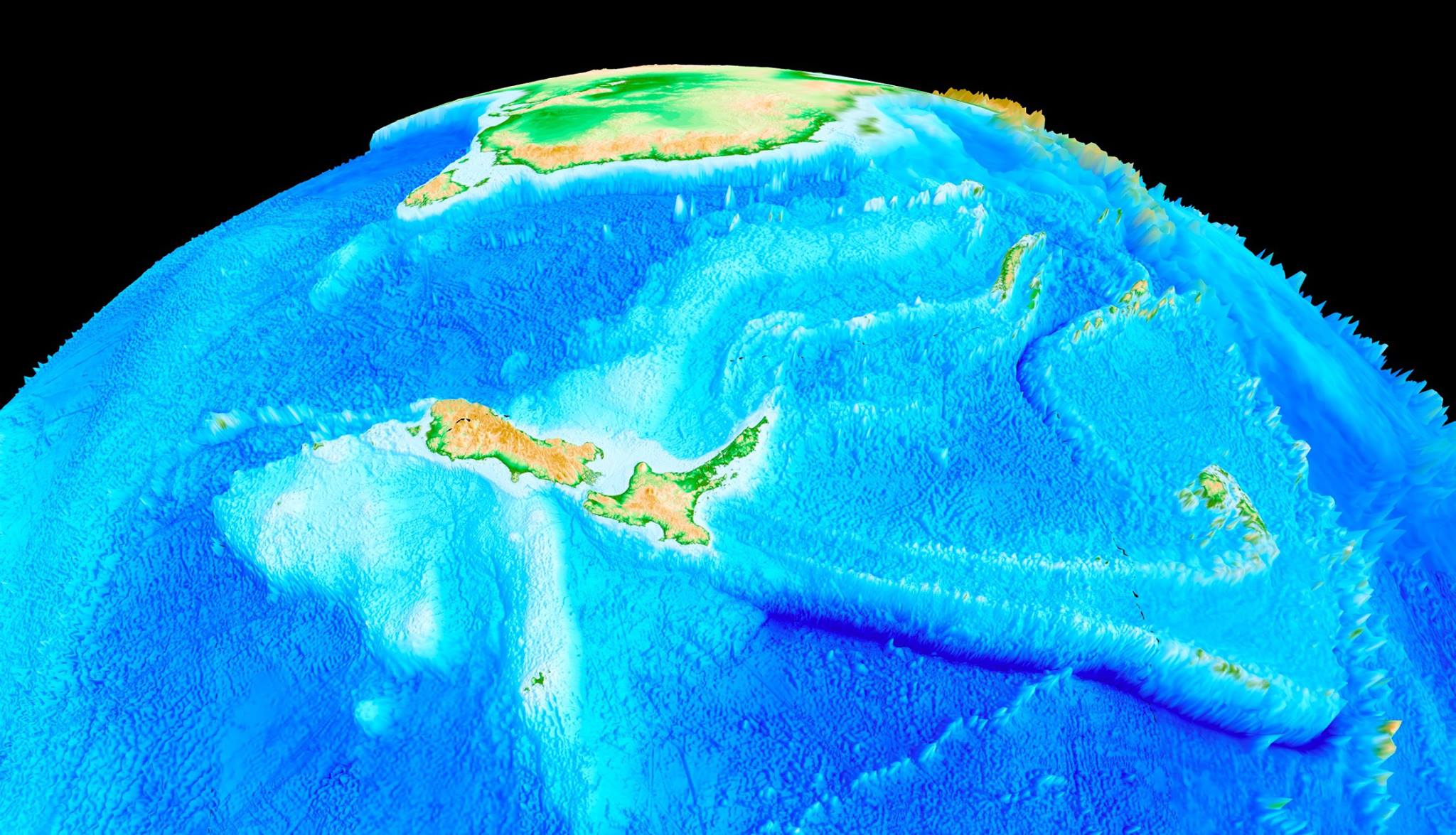
At first glance, Earth’s map seems settled. Continents appear fixed—named, counted and familiar. Yet over recent decades, geologists have been quietly revising that picture. One vast region in the southwest Pacific has repeatedly returned to scientific debate. Mostly submerged and stretching around New Zealand and New Caledonia, it does not behave like ordinary ocean floor. Its rocks, crustal thickness and overall shape point elsewhere.
This region, known as Zealandia, spans about 4.9 million square kilometres of continental crust. Nearly all of it lies below sea level, which is why it went unrecognised for so long. But as geological and geophysical data have improved, the evidence has grown compelling. Zealandia is not a scattered chain of islands—it fits the definition of a continent, even if it remains largely hidden.
A Vast Continental Landmass Beneath the Pacific
Continental crust differs fundamentally from oceanic crust. It is thicker, less dense and composed of a wider range of rocks. Zealandia matches these characteristics closely. Seismic studies reveal crust far thicker than the roughly seven kilometres typical of ocean floor, reaching more than forty kilometres in some areas.
Rock samples collected from islands and the seabed include granite, schist, greywacke and limestone—materials associated with continental environments, not the basaltic rocks that dominate oceanic crust.
Bathymetric mapping adds further evidence. Zealandia stands higher than the surrounding deep ocean basins, and its margins slope downward in a manner similar to other continental edges. Crucially, its outline is continuous rather than fragmented, reinforcing the idea of a single geological unit.
A Continent Shaped by Stretching and Sinking
Research outlined in “Zealandia: Earth’s Hidden Continent” suggests that Zealandia was once part of Gondwana, the ancient southern supercontinent. Around 80–90 million years ago, tectonic forces began stretching and thinning the crust. As Gondwana broke apart, Zealandia drifted away from Australia and Antarctica.
This thinning weakened the crust. It remained continental but lost enough buoyancy to subside. The result is a landmass that never fully re-emerged—explaining why about 94% of Zealandia now lies underwater. It is not simply submerged land, but continental crust that never rose back above sea level.
Geological Continuity Beneath Islands and Seafloor
New Zealand and New Caledonia provide rare glimpses into Zealandia’s interior. Mountain ranges, fault systems and ancient rock formations on land extend offshore in consistent, predictable patterns. Sedimentary basins across the region preserve a record of rifting, subsidence and later marine flooding.
Some of these basins contain sediment layers several kilometres thick, with histories that closely mirror those of eastern Australia. This continuity reflects their shared past before tectonic separation and supports the view of Zealandia as a unified continental block rather than a patchwork of fragments.
Size and Boundaries That Define a Continent
Scale is critical in geology, and Zealandia is immense—comparable in size to greater India before its collision with Asia. It is far larger than recognised microcontinents. Its boundaries are also clearly defined. Deep oceanic crust separates Zealandia from Australia, particularly across the Cato Trough, marking a genuine tectonic division rather than a superficial geographic one.
By standard geological criteria—elevation, crustal structure, composition and size—Zealandia qualifies as a continent.
Why Zealandia Matters
Recognising Zealandia does not redraw coastlines or add new land to the world’s maps. Instead, it reshapes understanding. It provides scientists with a rare, largely submerged example of continental breakup, rifting and thinning on a vast scale.
More broadly, Zealandia underscores a quiet truth about Earth science: the planet’s surface is still being reinterpreted. Some of the most significant revisions lie not in distant planets or deep space, but beneath the waves—waiting for enough evidence to bring them fully into view.