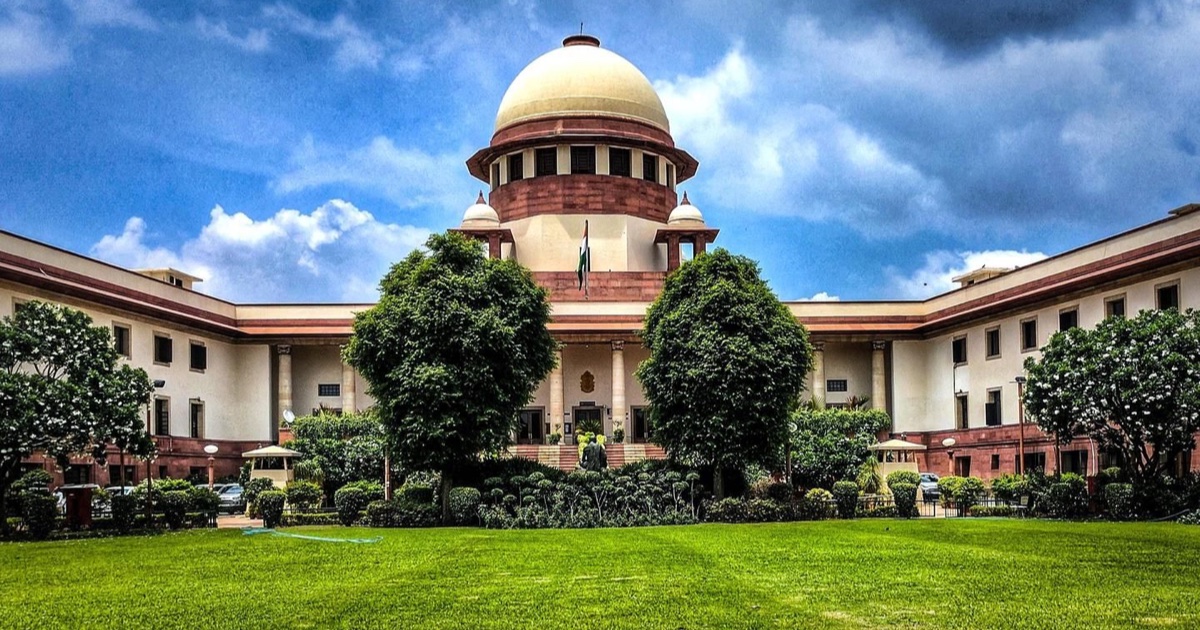
NEW DELHI: The Supreme Court on Tuesday directed all states to ensure adequate security for booth-level officers (BLOs) engaged in the Special Intensive Revision (SIR) of electoral rolls, warning that any threats, intimidation, or obstruction to their work would be viewed seriously.
The observations came from a bench comprising Chief Justice Surya Kant and Justice Joymalya Bagchi while hearing a petition filed by NGO Sanatani Sangsad. Appearing for the petitioner, senior advocate V. Giri alleged that BLOs in West Bengal were being intimidated and threatened while carrying out voter enumeration work, and sought security arrangements for them.
Representing the Election Commission (EC), senior advocate Rakesh Dwivedi informed the court that the poll panel had written a strongly worded letter to the West Bengal government regarding the safety of BLOs. He assured the bench that the EC had sufficient constitutional powers to address the situation, but noted that such issues arose because the Commission had no direct control over state police forces. The petitioner also sought the deployment of paramilitary forces in West Bengal to ensure the safety of BLOs.
Expanding the scope of the issue beyond a single state, the bench said non-cooperation with the EC’s work was a serious matter. “If the EC faces any grievance regarding lack of cooperation from state officials or police in ensuring the safety of BLOs, it should approach this court. We will pass appropriate orders. This is not confined to West Bengal but applies to all states. BLOs must be provided full security,” the bench observed.
Seeking responses from the Centre and the EC, the court asked the poll panel to assess the ground situation across all states and, if necessary, approach the Supreme Court for suitable directions. “We will take strong action to protect BLOs. Their safety and security must be ensured; otherwise, it will lead to anarchy,” the CJI-led bench said, while referring to its December 4 order that allowed BLOs facing stress or health issues to withdraw from SIR work and directed states to provide adequate replacements.
During the hearing, Dwivedi and senior advocate Maninder Singh said similar problems were being reported in Tamil Nadu, Kerala, and West Bengal, as some state governments had publicly opposed the SIR exercise. The bench clarified that BLOs unwilling to perform SIR duties must submit an application to the district electoral officer, who would then inform the state authorities.
Justice Bagchi, however, questioned the material placed by Sanatani Sangsad to support claims of intimidation in West Bengal. “Apart from a solitary FIR, there is no other credible evidence. Can an allegation based on a single incident justify saying this is happening only in West Bengal and not elsewhere? Is this not a one-sided narrative?” he asked.
The EC acknowledged that there had been instances in West Bengal where electoral officials were gheraoed and threatened by members of the public, but added that several narratives were being floated by political parties. The poll panel said a BLO is currently required to enumerate a maximum of 1,200 voters over 37 days—roughly 35 voters per day—and questioned whether this amounted to excessive workload.
Justice Bagchi responded that the task involved fieldwork, not desk duties, and could involve physical strain and stress. “A BLO must go door to door, verify forms, and upload data. We want to ensure that the SIR process at the ground level is carried out smoothly,” he said.
When the EC argued that claims of stress among BLOs were being exaggerated by political parties, the Chief Justice noted that this was precisely why the court had directed states on December 4 to augment manpower for the SIR exercise.