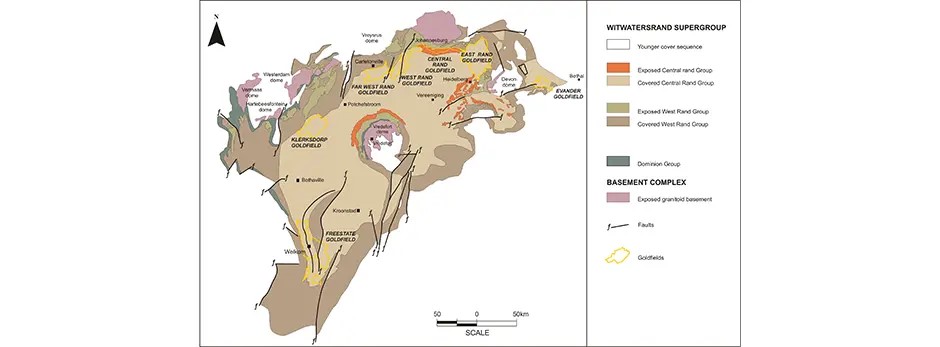
A vast geological formation beneath Johannesburg has produced more gold than any other place on Earth. The Witwatersrand Basin, formed roughly 2.7 billion years ago, is estimated to have yielded around 40% of all the gold ever mined worldwide.
Despite more than a century of intensive extraction, geologists believe the basin may still hold gold reserves worth up to half a trillion dollars, making it one of the most extraordinary mineral deposits in human history.
How Ancient Rivers Created the World’s Richest Gold Deposits
The Witwatersrand Basin is not a single mountain of metal but a huge sedimentary basin made of layered rocks formed by ancient rivers and floodplains.
Nearly three billion years ago, rivers flowed across volcanic terrains known as greenstone belts, eroding mineral-rich rocks and carrying fragments downstream. Because gold is extremely dense, it quickly settles in moving water. Over time, it accumulated in riverbeds and gravel bars.
As layers of sediment piled up, these deposits were buried deep underground. Heat and pressure eventually compressed them into hard conglomerate rock, preserving the ancient river gravels. Geologists refer to such deposits as palaeoplacers—ancient placer deposits that have been transformed into stone.
Many gold particles found in the basin still have rounded shapes, showing they were once transported by flowing water before becoming trapped in rock during the Archean Eon.
Scientific Debate and Modern Evidence
For decades, scientists debated whether the gold formed directly in ancient river sediments or was later introduced by underground hydrothermal fluids.
Research from the University of Arizona helped resolve much of the debate. Isotopic studies of minerals in the basin showed that the gold likely originated from erosion of nearby greenstone belts, supporting the palaeoplacer theory.
The surrounding rocks date back 2.7–3 billion years, a time when Earth was dominated by microbial life and complex plants or animals had not yet evolved. As a result, the basin also provides valuable clues about early continental formation and Earth’s ancient environments.
The Gold Discovery That Built Johannesburg
The basin’s economic importance became clear in 1886, when gold was discovered along the Witwatersrand ridge. Soon afterward, Paul Kruger declared the area open for public gold digging.
Within months, a small mining camp transformed into the city of Johannesburg. Early settlements such as Ferreira’s Camp grew rapidly as prospectors and investors arrived from around the world.
Land at Randjeslaagte—government land between farms—was surveyed and auctioned, laying the foundations for the city. By the late 19th century, Johannesburg had become one of the world’s fastest-growing mining towns, with its population surpassing 100,000 within a decade.
Mining at Extreme Depths
As easily accessible deposits were exhausted, mining companies began digging deeper underground. The Witwatersrand Basin pioneered deep-level mining, with some shafts extending more than 4 kilometres below the surface.
At such depths, conditions are extreme:
- Rock temperatures can exceed 50°C
- High pressure increases the risk of seismic rock bursts
- Sophisticated cooling and refrigeration systems are required to make tunnels habitable
A Geological Treasure Still Yielding Gold
Formed during the Archean era and first mined in 1886, the Witwatersrand Basin remains the most productive gold region in human history. Even today, geological surveys indicate that significant deposits still lie deep underground.
Although annual production has declined from its peak, the basin continues to shape South Africa’s economy and scientific understanding of Earth’s earliest geological processes—making it one of the planet’s most remarkable natural treasures.